

Öz
Amaç: Bu çalışma, sigara bırakma tedavisinde nikotin oral spreyi (NOS) kullanan hastaların gerçek yaşam verilerini inceleyerek sosyodemografik özellikleri, tedaviye uyum, yan etki profili, sprey kullanım miktarı ve erken dönem bırakma başarısı arasındaki ilişkileri değerlendirmeyi amaçlamıştır.
Yöntem: Tek merkezli ve retrospektif çalışmada, NOS reçetelenen 110 hastanın verileri taranmış; tedaviyi başlatan ve kontrole gelen 72 hasta analize dahil edilmiştir. Hastaların sosyodemografik verileri, Fagerström Nikotin Bağımlılık Testi skorları, sigara tüketim özellikleri, sprey kullanım miktarları ve 3 aylık tedavi sonuçları değerlendirilmiştir.
Bulgular: Çalışmaya dahil edilen hastaların yaş ortalaması 42,18±12,70 olup %48,6’sı kadındı. Erken dönem bırakma oranı %38,9, başarısızlık oranı %38,9 ve nüks oranı %22,2 olarak saptandı. Yan etki görülme oranı %26,3 idi; en sık boğazda yanma (%35,3), bulantı (%23,5) ve retrosternal yanma (%17,6) bildirildi. Yan etki varlığı ile nüks arasında güçlü ilişki saptandı (p=0,005) ve tedaviyi bırakanların %41,7’si yan etki bildirmişti (p=0,045). Eğitim düzeyi ile bırakma başarısı arasında anlamlı ilişki bulundu (p=0,039). Sprey kullanım miktarı, istek sayısı(r=0,65, p<0,001) ve günlük sigara tüketimi (r=0,42, p=0,004) ile ilişkili bulundu ancak bırakma başarısı ile arasında ilişki saptanmadı.
Sonuç: NOS, istek kontrolünde etkili olmakla birlikte, bırakma başarısını tek başına belirlememektedir. Yan etki gelişimi nüks riskini artırmakta, bu nedenle erken dönemde yan etki yönetimi ve doğru kullanım eğitimi kritik önem taşımaktadır. Bulgular, NOS tedavisinin klinik uygulamadaki yerine ilişkin gerçek yaşam verileri sunmaktadır.
Anahtar Kelimeler: sigara, nikotin bağımlılığı, nikotin replasman tedavisi, nikotin oral sprey
Giriş
Tütün bağımlılığı, dünya genelinde önlenebilir hastalık ve ölüm nedenlerinin başında gelmektedir.1 Nikotin, mezolimbik ödül sistemini aktive ederek dopaminerjik yanıtı artırmakta ve bu durum sigara bırakma sürecini zorlaştıran güçlü bir bağımlılık döngüsü oluşturmaktadır.2 Bu nedenle, yalnızca davranışsal müdahalelere dayalı girişimler çoğu hastada yetersiz kalmakta; farmakolojik tedavilerle desteklenen bütüncül yaklaşımlar sigara bırakma başarısını artırmaktadır.3
Nikotin replasman tedavileri (NRT), kontrollü nikotin alımı sağlayarak yoksunluk belirtilerini azaltmakta, sigara isteği şiddetini hafifletmekte ve kullanıcıların sigarayı bırakma sürecine daha iyi uyum göstermesine yardımcı olmaktadır. Transdermal bant gibi uzun etkili NRT formları bazal nikotin düzeyini sağlarken, sakız, pastil, inhaler ve sprey gibi hızlı etkili ürünler ani sigara içme isteğini azaltarak etki gösterir.4 Nikotin oral sprey (NOS), hızlı etkili NRT seçenekleri arasında öne çıkan bir formdur. Oral mukozadan hızla emilerek plazma nikotin düzeyinde dakikalar içinde yükselme sağlar ve bu farmakokinetik avantaj, özellikle tetikleyicilerle ilişkilendirilen ani istek ataklarını baskılamada önemlidir.5 Diğer formlar gibi davranış terapisi ile beraber uygulandığında daha yüksek oranda başarı sağlamaktadır.6 Yapılan çalışmalar, NOS’un ani istek kontrolünde sakız ve pastile göre daha hızlı etki sağladığını göstermektedir.5 Ayrıca esnek dozlanabilmesi, kullanıcıların sigara isteklerinin şiddetine göre kendi kullanım miktarlarını ayarlayabilmesini sağlamaktadır. Bununla birlikte, boğazda yanma, ağızda irritasyon veya bulantı gibi yan etkiler tedavi uyumunu etkileyebilmektedir.7 Her ne kadar klinik araştırmalarda NOS’un etkinliğine ilişkin veriler bulunsa da, gerçek yaşam koşullarında kullanım miktarları, tedaviye uyum, yan etki profili ve sigara bırakma başarısı arasındaki ilişkileri inceleyen çalışmalar oldukça sınırlıdır.
Bu çalışmanın amacı, sigara bırakma polikliniğine başvuran ve nikotin oral sprey tedavisi başlanmış hastaların sosyodemografik ve klinik özelliklerini, tedaviye devam etme durumlarını, yan etki profillerini ve sigara bırakma başarı oranlarını retrospektif olarak değerlendirmektir. Ek olarak, sprey kullanım miktarı ile bağımlılık ölçümleri ve yan etki gelişimi arasındaki ilişkilerin değerlendirilmesi hedeflenmiştir.
Gereç ve Yöntem
Bu araştırma, tek merkezli, retrospektif ve tanımlayıcı bir klinik çalışmadır. Çalışma, Şişli Hamidiye Etfal Eğitim ve Araştırma Hastanesi Sigara Bırakma Polikliniğine 01/07/2024 ile 01/11/2025 tarihleri arasındaki başvuran, NOS tedavisi önerilmiş ve tedaviyi en az 1 ay süre ile kullanmış olan hastaların erken dönem (ilk üç ay) verilerinin değerlendirilmesiyle gerçekleştirildi.
Çalışma retrospektif planlanmış olup belirlenen tarih aralığında kriterlere uygun olan tüm hastalar çalışmaya dahil edildi. Veri taraması sonucunda NOS tedavisi önerilmiş hasta sayısının 110 olduğu saptandı. Bu hastaların %37,5’i (n=9) kontrol randevusuna gelmemişti. Hastaların %26,4’ünün (n=29) ise önerilen tedaviye hiç başlamadığı belirlendi. Tedaviye başlamayan 29 hastanın nedenleri incelendiğinde; %13,7’sinin (n=4) ücret nedeniyle, %13,7’sinin (n=4) tedaviden fayda görmeyeceğini düşündüğü için, %6,8’inin (n=2) spreyi temin edemediği için, %6,8’inin (n=2) tedaviyi kullanmaktan vazgeçtiği için, %34,4’ünün (n=10) tedaviye ihtiyaç duymadığını düşündüğü için ve %24,1’inin (n=7) ise sigarayı bırakmaya hazır hissetmediği için reçete edilen tedaviyi kullanmadığı tespit edildi. Çalışmaya dahil edilen kişi sayısı 72 idi (Tablo 1). Örneklem yeterliliği, 110 kişilik hedef evrende incelenen 72 hasta kaydı üzerinden değerlendirilmiş ve %95 güven düzeyinde %6,8 örnekleme hatası hesaplanmıştır. Bu değer, çalışmanın örnekleminin evreni temsil etmede yeterli düzeyde hassasiyet sağladığını göstermektedir. Hastaların yaş, cinsiyet, eğitim, gelir durumu ve kronik hastalık varlığı kaydedilmiştir. Sigara maruziyetinin değerlendirilmesi için sigara paket/yıl verileri kaydedilmiştir. Bağımlılık düzeyinin değerlendirilmesinde Fagerström Nikotin Bağımlılık Testi (FBNT) kullanılmıştır. 6 maddeden oluşan ve 0-10 puan arasında skorlanan standardize bir ölçektir. Skorlama şu şekildedir: 0-2 puan (çok düşük), 3-4 puan (düşük), 5 puan (orta), 6-7 puan (yüksek), 8-10 puan (çok yüksek bağımlılık). Test, nikotin bağımlılığının biyokimyasal göstergeleri ile yüksek korelasyon göstermekte ve tedavi planlamasında yaygın olarak kullanılmaktadır.8
| ¹Tedaviye başlamayanlar içindeki yüzde (n=29) ²Tedaviye başlayanlar içindeki yüzde (n=81) | |||
| Tablo 1. Çalışma popülasyonunun belirlenmesi: hasta akış şeması | |||
| Aşama |
|
|
Açıklama |
| Başlangıç Popülasyon |
|
|
Nikotin oral sprey tedavisi önerilen tüm hastalar |
| Tedaviye Başlamayanlar |
|
|
Reçete edilmesine rağmen tedaviyi kullanmayanlar |
| Maddi nedenler |
|
|
|
| Tedaviye inanç eksikliği |
|
|
|
| Erişim problemi |
|
|
|
| Tedaviyi reddetme |
|
|
|
| Motivasyon eksikliği |
|
|
|
| Psikolojik hazır olmama |
|
|
|
| Tedaviye Başlayanlar |
|
|
Tedaviyi kullananlar |
| Takipten çıkanlar |
|
|
|
| Takibe devam edenler |
|
|
|
| Analize Dahil Edilen |
|
|
Final çalışma popülasyonu |
Nikotin oral sprey tedavisi sigara içme isteklerinin kontrol etmek amacıyla kullanılan ve sıkılan her puff ile 1 mg nikotin sağlayan bir yöntemdir. Kişinin yöntem kullanmaya başladığı gün, sigara bırakma günüdür. Sigara içme isteği geldiğinde kişi ağız içine mukozal bölgeye 1 puff sprey sıkar. Birkaç dakika içinde istekte azalma olmazsa 2. puff’u sıkabilir, diğer isteklerde 2’şer puff şeklinde devam edebilir. Her 30 dakikada en fazla 2 puff, 1 günde 64 puff aşılmamalıdır. Kişiye günde 10 defa istek geliyorsa, günde 10 defa 1 veya 2 puff kullanabilir.9
Sprey tedavisine uyum, ilk kontroldeki (1. hafta) sigara içme isteği sayısı, günlük sprey kullanım miktarı, yan etki bildirimleri ve ilaç düzenli kullanım durumları kaydedildi. Üç ayın sonunda sigarayı bırakmış hastalar başarılı, hiç bırakamayan hastalar başarısız ve ilk bırakma sonrası bu süre içinde yeniden sigaraya başlayan hastalar nüks olarak sınıflandırıldı. Sprey tedavisine 3 aylık takip süresince kullanmaya devam eden hasta devamlı kullanım olarak değerlendirildi.
Tüm istatistiksel analizler IBM SPSS istatistiksel yazılımı, sürüm 25.0 kullanılarak gerçekleştirildi. Tanımlayıcı istatistikler, kategorik değişkenler için frekans ve yüzde olarak; sürekli değişkenler için ise ortalama, standart sapma, minimum ve maksimum değerler şeklinde verildi. Bağımsız gruplar arasındaki oran farkları Ki-kare testi ile değerlendirildi. Normal dağılım gösteren sürekli değişkenlerde iki grup karşılaştırmaları için Bağımsız Örneklem T testi kullanılırken, normal dağılım göstermeyen değişkenler için Mann–Whitney U testi uygulandı. Normalite varsayımının sağlanmadığı durumlarda üç bağımsız grubun karşılaştırılması için Kruskal–Wallis H testi, varsayımın sağlandığı durumlarda ise tek yönlü ANOVA kullanıldı. Değişkenlerin dağılımının normalliği Kolmogorov–Smirnov testi ile değerlendirildi. Etik kurul onayı İstanbul Şişli Hamidiye Etfal Eğitim ve Araştırma Hastanesi 11.11.2025 tarihli 5146 onay numarası ile alındı.
Bulgular
Çalışmaya NOS tedavisini kullanan ve kontrollere gelmiş toplam 72 hastanın verileri dahil edildi. Yaş ortalaması 42,18±12,70 (min:18, max:62) olup %48,6’sı (n=35) kadındı. Hastaların %63,9’u (n=46) lise ve altı eğitim düzeyine, %47,2’si (n=34) asgari ücret ve altı gelir düzeyine sahipti. %54,2’sinin (n=39) kronik hastalığı yoktu. Ortalama FBNT skoru 4,66±3,08 (min:1, max:10), sigara paket/yıl ortalaması ise 22,71±20,83 idi (min:1, max:130).
İlk kontrolde sorgulanan sigara istek sayısı 7,88±9,12 (min: 1, max: 40) idi. Tedavi sonrası ilk hafta kontrolünde ortalama günlük sprey kullanım miktarı 4,15±4,96 puff (min: 1, max: 40) olarak bulundu.
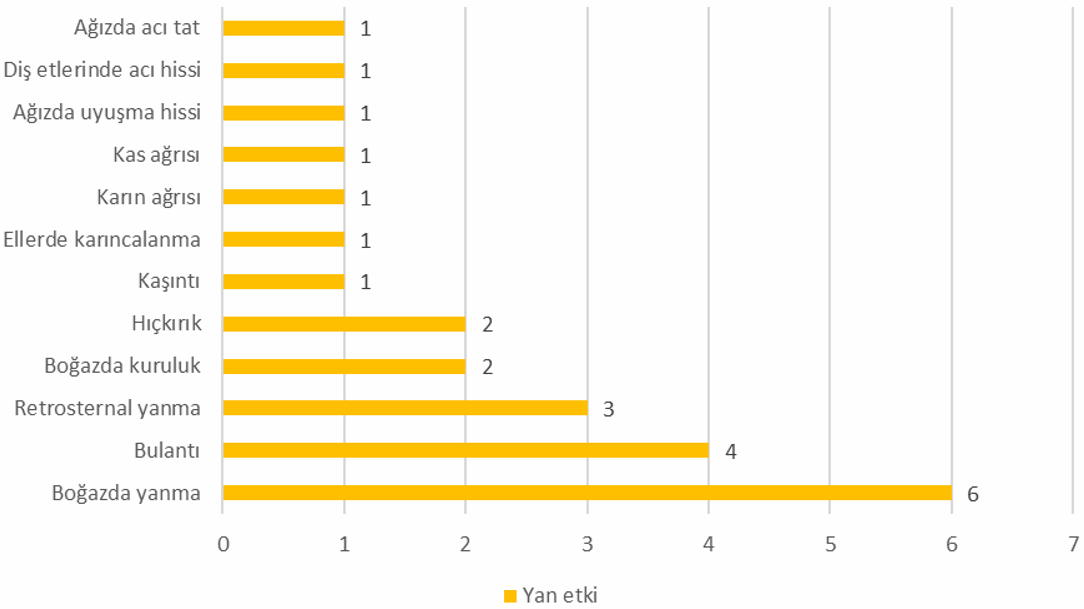
Katılımcıların %26,3’ü (n=19) yan etki bildirmiş olup en sık boğazda yanma (n=6, %35,2), bulantı (n=4, %23,5) ve retrosternal yanma (n=3, %17,6) görüldü (Şekil 1).
Tablo 2’de görüldüğü gibi yan etki gelişimi ile sosyodemografik değişkenlerden cinsiyet, gelir, eğitim, kronik hastalık arasında anlamlı bir ilişki saptanmadı (sırasıyla p=0,494, p=0,494, p= 0,155, p=0,531). Yan etki ile tedaviye düzenli devam etme durumu arasında anlamlı ilişki saptandı (p=0,045); tedaviye düzenli devam etmeyenlerin %41,7’si (n=10), düzenli devam edenlerin %18,8’i (n=9) herhangi bir yan etki bildirmiş idi. Yan etki ile yaş ve FBNT skorları arasında uygulanan Independent Samples T testinde anlamlı bir ilişki saptanmadı (sırasıyla p=0,647, p=0,595). Yan etki ile sigara paket/yıl ve günlük sprey miktarı arasında Mann–Whitney U testi sonuçlarına göre anlamlı bir ilişki saptanmadı (sırasıyla p=0,353, p=0,438).
| Ki-kare | ||||
| Tablo 2. Nikotin oral spreye bağlı yan etki varlığının sosyodemografik faktörler ve spreyi düzenli kullanım ile ilişkisi % (n) | ||||
| Değişken | Kategori |
|
|
|
| Cinsiyet | Kadın |
|
|
|
| Erkek |
|
|
||
| Eğitim | Lise ve altı |
|
|
|
| Üniversite ve üstü |
|
|
||
| Gelir | Asgari ve altı |
|
|
|
| Asgari üstü |
|
|
||
| Kronik hastalık | Yok |
|
|
|
| Var |
|
|
||
| Spreyi düzenli kullanım durumu | Düzenli kullanmamış |
|
|
|
| Düzenli kullanmış |
|
|
||
Tablo 3’te bırakma sonrası dönemde ilk kontrolde sorgulanan sigara istek sayısı ile sprey miktarı arasında istatistiksel olarak anlamlı ilişki saptandı (r=0,65, p<0,001). İstek sayısı arttıkça sprey kullanım miktarı da artma eğiliminde idi. Benzer şekilde, günlük sigara tüketimi ile sprey miktarı arasındaki ilişki de anlamlı bulundu (r=0,42, p=0,004). Günlük sigara miktarı arttıkça sprey kullanım miktarı da artmakta idi. Günlük sprey miktarı ile sigara paket/yıl arasında pozitif yönlü zayıf ilişki bulundu (r=0,26, p=0,029). Sigara paket/yıl değeri arttıkça günlük sprey miktarı da artma eğiliminde idi. İstek sayısının tedavi başarısı ile ilişkisini incelemek amacıyla Mann-Whitney U testi uygulandı. Test sonucunda, başarı gösteren katılımcıların istek sayılarının ortalama sıralaması 18,24, başarısız olanların ise 26,33 olarak bulundu. (U=143,5, p = 0,034).
| Tablo 3. Nikotin oral sprey kullanım miktarı ile istek sayısı, günlük sigara tüketimi ve sigara paket/yıl miktarı arasındaki korelasyon sonuçları | ||
| Değişkenler arası ilişki |
|
|
|
|
|
|
| İstek Sayısı |
|
|
| Günlük Sigara Tüketimi |
|
|
| Sigara Paket/Yıl |
|
|
Nikotin oral sprey tedavisini düzenli kullananların oranı %69,4 (n=50) idi. 3 aylık sigara bırakma sonuçları değerlendirildiğinde %38,9’unun (n=28) başarılı, %38,9’unun (n=28) başarısız olduğu ve %22,2’sinin (n=16) nüks yaşadığı gözlendi.
Tablo 4‘te başarı durumu ile sosyodemografik değişkenler incelendiğinde cinsiyet, gelir düzeyi ve kronik hastalık varlığı arasında anlamlı bir ilişki saptanmadı (p>0,05). Buna karşılık, eğitim düzeyi ile başarı arasında istatistiksel olarak anlamlı bir ilişki saptandı (p=0,039); daha yüksek oranda üniversite ve üzeri eğitim düzeyine sahip olan hastaların başarı oranı daha (p=0,005). Yan etki bildirme oranı nüks grubunda %52,9 ile belirgin şekilde yüksek olup, başarılı grupta %36,8 ve başarısız grupta %15,7 idi.
| Ki-kare | |||||
| Tablo 4. Nikotin oral sprey tedavisi alanlarda sigara bırakma başarısı ile belirli değişkenlerin ilişkisi % (n) | |||||
| Değişken | Kategori |
|
|
|
|
| Cinsiyet | Kadın |
|
|
|
|
| Erkek |
|
|
|
||
| Eğitim | Lise ve altı |
|
|
|
|
| Üniversite ve üstü |
|
|
|
||
| Gelir | Asgari ve altı |
|
|
|
|
| Asgari üstü |
|
|
|
||
| Kronik hastalık | Yok |
|
|
|
|
| Var |
|
|
|
||
| Yan etki | Yan etki yok |
|
|
|
|
| Yan etki var |
|
|
|
||
| Spreyi düzenli kullanım durumu | Düzenli kullanmamış |
|
|
|
|
| Düzenli kullanmış |
|
|
|
||
Başarı durumu ile günlük sprey kullanım miktarı arasında da Kruskal-Wallis H testi sonuçlarına göre anlamlı bir ilişki saptanmadı (p=0,995). Başarı durumu ile yaş, FBNT skoru ve sigara paket/yıl değerleri arasında One-way ANOVA analizine göre anlamlı ilişki saptanmadı (sırasıyla p=0,568, p=0,281, p=0,387).
Tartışma
Bu çalışmada NOS tedavisi başlanan hastaların ilk 3 ay sonuçları üzerinden tedavi başarısının değerlendirilmesi ve sigara bırakma başarını etkileyen faktörlerin saptanması amaçlanmıştır.
Nikotin oral sprey ile yapılan çalışmalarda yan etkiler sıklıkla hafif- orta düzeyde raporlanmış olup lokal irritasyon bulguları ön plandadır.7,10-11 Yapılan bir randomize kontrollü çalışmada, NOS grubunda yan etki oranı %87,4 olarak saptanmış olup, yan etkiler nedeniyle tedavi bırakma oranı yalnızca %9,1 düzeyinde kalmıştır.11 Bu durum, yan etkilerin çoğunlukla tolere edilebilir düzeyde olduğunu göstermektedir. Bununla birlikte, çalışmalar nikotin sprey formlarında lokal yan etki bildirme oranının diğer kısa etkili NRT formlarına (sakız, inhaler ve pastil) kıyasla daha yüksek olduğunu göstermektedir.7,12 Çalışmada da NOS tedavisine bağlı yan etki bildirenlerin oranı %26,3 olup bunların çoğunluğu boğazda yanma şikayeti idi. Bu bulgular, üretici firma tarafından bildirilen çok yaygın (>%10) yan etki profili ile örtüşmektedir.9 Literatüre bakıldığında ise yan etkilere göre prevelanslar şu şekildedir: boğaz iritasyon %22,9-%39,6, baş ağrısı %11-%32,4, bulantı %13-%31,8, ağızda/boğazda yanma hissi %35, tükrük hipersekresyonu %5,5-%9 ve hıçkırık %57 civarında raporlanmıştır.7,10,12-13
Literatürde dozlama hataları ya da yanlış sprey tekniği gibi spesifik kullanım hataları ile yan etkiler arasındaki ilişkiyi inceleyen çalışmalar sınırlı olsa da, bazı derlemelerde bireysel kullanım alışkanlıklarının (örneğin; doz miktarı, kullanım sıklığı ve süresi) oral yan etki riskini ve şiddetini etkileyebileceği belirtilmiştir.14-15 Aşırı kullanım ya da yanlış uygulama, lokal iritasyon veya diğer yan etkilerin görülme olasılığını artırabilir.12
Çalışmada NOS tedavisi alanlarda erken dönem sigara bırakma oranı %38,9 olarak saptanmıştır. Literatürde bildirilen randomize kontrollü çalışmalarla karşılaştırıldığında, bu oranın çalışmada daha yüksek olduğu görülmektedir. Tonnesen ve ark. tarafından yapılan bir randomize kontrollü çalışmada NOS grubunda 2 ile 6. haftalar arasındaki bırakma oranı %26,1 olup plaseboya göre (%16,1) anlamlı derecede yüksek saptanmıştır. 24. haftada NOS grubunda %15,7, plasebo grubunda %6,8 ve 52. haftada NOS grubunda %13,8, plasebo grubunda %5,6 oranında başarı sağlanmıştır.13 Başka bir randomize kontrollü çalışmada ise 2-6. hafta arası NOS grubunda bırakma oranı %5 olup plaseboya göre (%2,5) anlamlı derecede yüksek saptanmıştır.16 Çalışmada saptanan bu yüksek oran, araştırmanın sigara bırakma polikliniğine başvuran motivasyonu yüksek hastaları içermesinden kaynaklanıyor olabilir.
Geniş ölçekli popülasyon çalışmalarında, yan etkiler NRT’yi bırakma nedenlerinin %4 ila %18’ini oluştururken, nüks %34 - %42 oran aralığında en yaygın neden olarak bildirilmiştir.17 Yaklaşık 1200 kişinin değerlendirildiği ve büyük çoğunluğunu NRT kullanan hasta grubunun oluşturduğu bir çalışmada, erken dönemde sigara bırakma tedavisini bırakanlarda bildirilen en sık neden %41,6 oranla nüks olurken yan etkiler %18,3 oranla ikinci sırada gelmiştir.18
Çalışmada nüks oranı %22,2 olup; yan etki yaşayan bireylerde nüksün daha yüksek olduğu görülmüştür. Bu durum, yan etkilerin tedavi uyumunu azaltarak istek artışına ve dolayısıyla nükse yol açabilecek bir döngüyü tetikleyebileceğini düşündürmektedir. Literatürde kısa etkili NRT’lerde lokal irritasyonun tedavi bırakma ile ilişkili olabileceği bildirilmektedir. Yapılan bir çalışmada kısa etkili NRT formlarının oral yan etki profili incelenmiş ve bu yan etkilerin tedavi bırakma oranları ile ilişkili olabileceği bildirilmiştir.19 Bu nedenle, yan etkilerin erken tespiti ve etkin şekilde yönetilmesinin; tedavinin tolere edilebilirliğini artırarak tedavi uyumunu destekleyeceğini ve nüks riskini azaltmada önemli bir rol oynayabileceği düşünmekteyiz.
Çalışmada günlük sprey kullanım miktarının, hem sigara maruziyeti hem de bırakma sonrası istek sayısı ile pozitif korelasyon göstermesi, NOS’un esnek dozlama özelliğinin klinik pratikte etkin kullanıldığını düşündürmektedir. Bu durum aynı zamanda NOS kullanımının hem fizyolojik yoksunluk hem de davranışsal bağımlılık komponentlerine yanıt verdiğini göstermekte ve Tonnesen ve arkadaşlarının ağır içicilerde doz titrasyonunun önemine değindiği çalışma ile uyumluluk göstermektedir.11 Ancak çalışmada, artan sprey kullanımı tedavi başarısına yansımamış olup bu durum yüksek nikotin bağımlılığının sadece farmakolojik müdahaleyle aşılamayabileceğini ve çok boyutlu yaklaşımların gerekli olabileceğini göstermektedir.
Çalışmada üniversite mezunlarında sigara bırakma başarı oranı, lise ve altı eğitim grubuna kıyasla anlamlı derecede yüksek saptanmıştır. Yüksek eğitim düzeyi, ve gelişmiş sağlık okuryazarlığı tedavi uyumunu artırarak başarı şansını artırıyor olabilir.20 Literatürde eğitim düzeyinin yanı sıra yaş, cinsiyet ve medeni durum gibi sosyodemografik faktörlerin de sigara bırakma başarısı üzerine etkileri olduğu görülmektedir.20-22 Sosyodemografik değişkenlerin yanı sıra, bağımlılık şiddeti, motivasyon düzeyi, sosyal destek varlığı ve komorbid durumlar da tedavi yanıtını şekillendiren diğer önemli faktörlerdir.20,23 Çalışmada cinsiyet, gelir durumu ve kronik hastalık varlığı ile tedavi başarısı arasında anlamlı ilişki saptanmamıştır. Bu durum, hasta popülasyonumuzun bu değişkenler açısından görece homojen dağılım göstermesi veya eğitim düzeyi ve yan etki varlığı gibi faktörlerin daha belirleyici rol oynaması ile açıklanabilir.
Bu çalışma, NOS tedavisinin gerçek yaşam koşullarındaki etkinliğini inceleyerek, klinik uygulamalara yönelik mevcut bilgi birikimine katkı sağlamayı ve tedavi yaklaşımlarının geliştirilmesine yönelik yeni veriler sunmayı amaçlamıştır.
Nikotin oral spreyin, tolere edilebilir bir tedavi olduğu ancak NOS tedavisinin başarısını artırmak için, tedavi uyumunun izlenmesi ve yan etkilerin erken dönemde yönetilmesinin fayda sağlayacağı kanaatine varılmıştır. Özellikle tedavinin ilk haftalarında yakın takip ve destek sağlanması, hem tedaviye uyumu artırabilir hem de erken dönem nüks riskini azaltabilir.
Etik kurul onayı
Bu çalışma İstanbul Şişli Hamidiye Etfal Eğitim ve Araştırma Hastanesi Etik Kurulu tarafından onaylanmıştır (onay tarihi: 11.11.2025, numarası: 5146).
Yazarlık katkısı
Çalışma konsepti ve tasarımı: : GZÖ; veri toplama: YGA; sonuçların analizi ve yorumlanması: YGA; makaleyi hazırlama: YGA, GZÖ. Yazar(lar) sonuçları gözden geçirmiş ve makalenin son halini onaylamıştır.
Finansman
Yazar(lar), çalışmanın herhangi bir finansal destek almadığını beyan etmiştir.
Çıkar çatışması
Yazar(lar) herhangi bir çıkar çatışması olmadığını beyan etmiştir.
Ethical approval
This study has been approved by the University of Health Sciences İstanbul Şişli Hamidiye Etfal Training and Research Hospital Ethics Committee (approval date: 11.11.2025, number: 5146).
Source of funding
The authors declare the study received no funding.
Conflict of interest
The authors declare that there is no conflict of interest.
Referanslar
- World Health Organization (WHO). Tobacco. 2025. Avaible at: https://www.who.int/news-room/fact-sheets/detail/tobacco (Accessed on Nov 6, 2025).
- Wittenberg RE, Wolfman SL, De Biasi M, Dani JA. Nicotinic acetylcholine receptors and nicotine addiction: a brief introduction. Neuropharmacology 2020; 177: 108256. https://doi.org/10.1016/j.neuropharm.2020.108256
- Hersi M, Beck A, Hamel C, et al. Effectiveness of smoking cessation interventions among adults: an overview of systematic reviews. Syst Rev 2024; 13: 179. https://doi.org/10.1186/s13643-024-02570-9
- Theodoulou A, Chepkin SC, Ye W, et al. Different doses, durations and modes of delivery of nicotine replacement therapy for smoking cessation. Cochrane Database Syst Rev 2023; 6: CD013308. https://doi.org/10.1002/14651858.CD013308.pub2
- Kraiczi H, Hansson A, Perfekt R. Single-dose pharmacokinetics of nicotine when given with a novel mouth spray for nicotine replacement therapy. Nicotine Tob Res 2011; 13: 1176-1182. https://doi.org/10.1093/ntr/ntr139
- Caldwell BO, Adamson SJ, Crane J. Combination rapid-acting nicotine mouth spray and nicotine patch therapy in smoking cessation. Nicotine Tob Res 2014; 16: 1356-1364. https://doi.org/10.1093/ntr/ntu084
- Hansson A, Hajek P, Perfekt R, Kraiczi H. Effects of nicotine mouth spray on urges to smoke, a randomised clinical trial. BMJ Open 2012; 2: e001618. https://doi.org/10.1136/bmjopen-2012-001618
- Atilla Uysal M, Kadakal F, Karşidağ Ç, et al. Fagerstrom test for nicotine dependence: reliability in a Turkish sample and factor analysis. Tüberküloz ve Toraks Derg. 2004;52(2):115-121.
- Nikitabs Kısa Ürün Bilgisi. 2025 Avaible at: https://www.nobel.com.tr/cmsfiles/turkey/products/nikitabs-1-5-mg-film-kapli-tablet-short-product-info-1.pdf?v=42 (Accessed on Mar 05, 2026).
- Danielsson T, Bennet H, McColgan B, Wang J. Effect of nicotine mouth spray on urges to vape: A randomized, placebo-controlled, pharmacodynamic clinical trial in exclusive e-cigarette users. Addiction 2025; 120: 95-105. https://doi.org/10.1111/add.16669
- Tonnesen P, Lauri H, Perfekt R, Batra A, Mann K. Efficacy and safety of a novel nicotine mouth spray in smoking cessation: a randomized, placebo-controlled, double blind, multicenter study with 52-week follow up. Eur Respir J. 2014;38(55):194. https://doi.org/10.1183/13993003/erj.38.Suppl_55.194
- Bolliger CT, van Biljon X, Axelsson A. A nicotine mouth spray for smoking cessation: a pilot study of preference, safety and efficacy. Respiration 2007; 74: 196-201. https://doi.org/10.1159/000097136
- Tønnesen P, Lauri H, Perfekt R, Mann K, Batra A. Efficacy of a nicotine mouth spray in smoking cessation: a randomised, double-blind trial. Eur Respir J 2012; 40: 548-554. https://doi.org/10.1183/09031936.00155811
- Rungraungrayabkul D, Gaewkhiew P, Vichayanrat T, Shrestha B, Buajeeb W. What is the impact of nicotine pouches on oral health: a systematic review. BMC Oral Health 2024; 24: 889. https://doi.org/10.1186/s12903-024-04598-8
- La Rosa GRM, Del Giovane C, Pedullà E, et al. Oral health effects of non-combustible nicotine products: protocol for a systematic review and network meta-analysis. Syst Rev 2025; 14: 90. https://doi.org/10.1186/s13643-025-02839-7
- Nides M, Danielsson T, Saunders F, et al. Efficacy and Safety of a Nicotine Mouth Spray for Smoking Cessation: a randomized, multicenter, controlled study in a naturalistic setting. Nicotine Tob Res 2020; 22: 339-345. https://doi.org/10.1093/ntr/nty246
- Burns EK, Levinson AH. Discontinuation of nicotine replacement therapy among smoking-cessation attempters. Am J Prev Med 2008; 34: 212-215. https://doi.org/10.1016/j.amepre.2007.11.010
- Balmford J, Borland R, Hammond D, Cummings KM. Adherence to and reasons for premature discontinuation from stop-smoking medications: data from the ITC Four-Country Survey. Nicotine Tob Res 2011; 13: 94-102. https://doi.org/10.1093/ntr/ntq215
- Sivaramakrishnan G, Alsobaiei M, Sridharan K. Oral side effects of locally delivered nicotine replacement therapy: a meta-analysis of randomized controlled trials. Int J Dent Hyg 2023; 21: 3-17. https://doi.org/10.1111/idh.12594
- Ermawan Effendi D, Ardani I, Handayani S, et al. Factors associated with quitting smoking among males: findings from Indonesian national health survey. Clin Epidemiol Glob Heal. 2024;28. https://doi.org/10.1016/j.cegh.2024.101672
- Alyousefi NA, Alquraini RS, Alyahya LF, Bin Hamad NM, Aljuribah DK, Aldossari KK. factors associated with successful smoking cessation among adults in saudi arabia-a cross-sectional study. Healthcare (Basel) 2025; 13: 1813. https://doi.org/10.3390/healthcare13151813
- Esmer B, Sengezer T, Aksu F, Özkara A, Aksu K. Clinical, sociodemographic and tobacco-use factors associated with smoking cessation rates at three years follow-up, Ankara, Turkey. Tob Prev Cessat 2019; 5: 47. https://doi.org/10.18332/tpc/114082
- Drumond Muzi C, Carvalho Figueiredo V, Raggio Luiz R. Health perception, health conditions, and smoking cessation in Brazil. Cad saúde colet. 2021;29. https://doi.org/10.1590/1414-462x202199010432
Telif hakkı ve lisans
Telif hakkı © 2026 Yazar(lar). Açık erişimli bu makale, orijinal çalışmaya uygun şekilde atıfta bulunulması koşuluyla, herhangi bir ortamda veya formatta sınırsız kullanım, dağıtım ve çoğaltmaya izin veren Creative Commons Attribution License (CC BY) altında dağıtılmıştır.